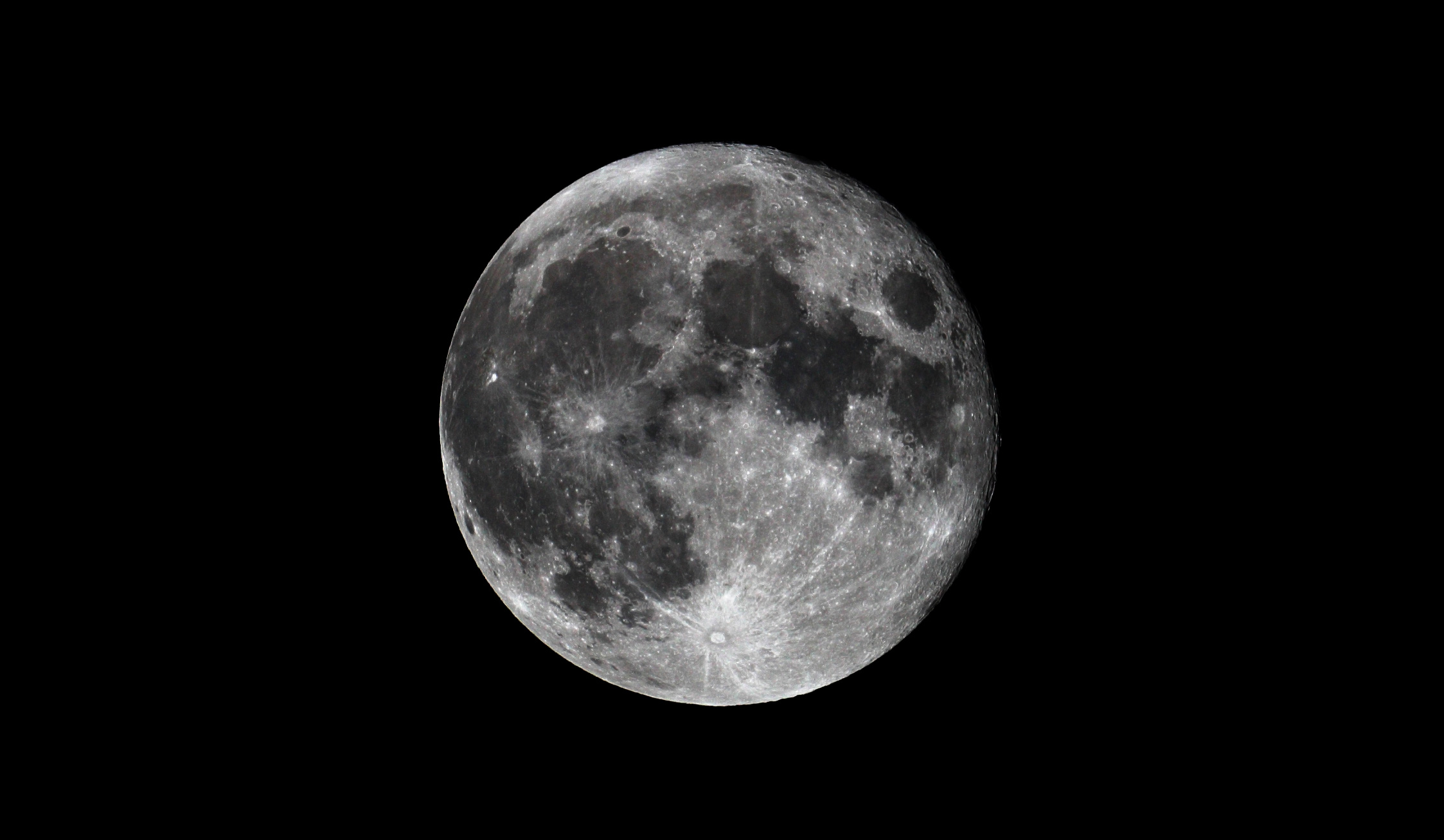
Full Moon Jan 12, 2017. Canon T3 @ ISO 100, 1/800 sec, TV-85 at F/5.6, Atlas EQ-G mount.
A close crop of the moon taken with the Canon T3 and TV-85 combo. This is straight out of the Canon DPP software. I cropped it in PS, but didn’t do any other modifications to it.
This was a shakedown imaging session to test my mount, laptop and new Bluetooth telescope interface. Unfortunately, the test failed as the Bluetooth connection kept breaking. I had tested it a few nights before with no problems, but something I installed afterward must have screwed it up. It is back to the drawing board, I guess. 🙁
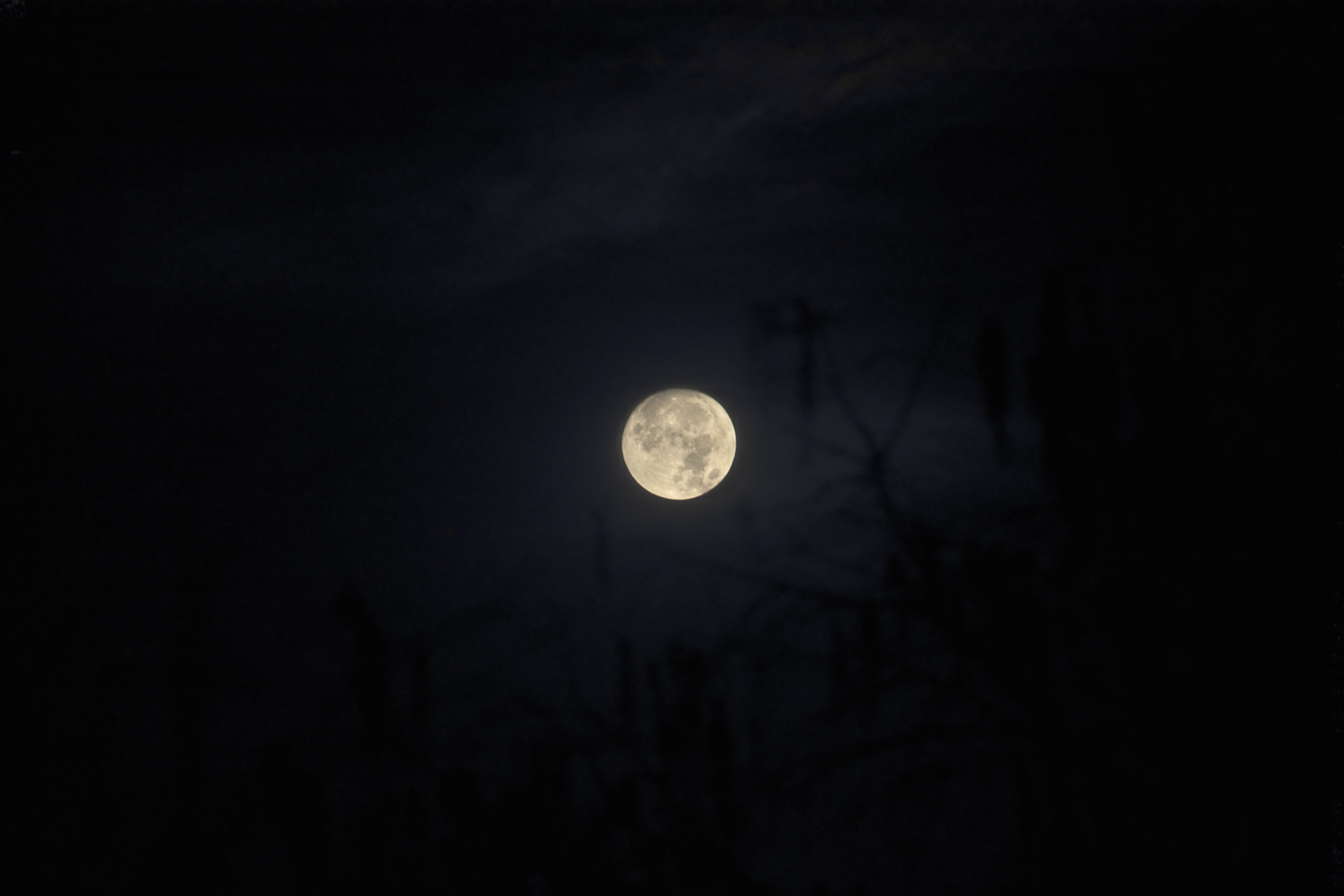
Moonset on Jan 11, 2017. Canon T3 @ ISO 400, Canon 200mm, F/2.8 telephoto, 1/320 sec for moon and 1/100 sec for background.
Here’s an image of the moon setting behind tree branches that I created recently. Of course the nearly full moon was way overexposed in the image taken for the background, but I overlayed another shot taken at a much shorter exposure and blended the two together until it looked somewhat natural.
The Moon on Jan 7, 2017. Televue TV-85 at F/7, Aptina AR0130 color planetary cam, 40 frames out of 291.
It is not much of an image, but it was done with my trusty TV-85 and my Atlas EQ-G tracking mount, instead of that dobsonian I’ve been stuck using.
I managed to get those two items back into my possession recently. Unfortunately, the Atlas mount needed lots of work just to get it barely running again. There is a burnt out motor on one of the drive axis. It was the RA motor, so I swapped it with the DEC motor to just get the tracking going. During testing I was able to take a one minute video with decent tracking, which yielded just over 290 frames with the planetary cam I used.
I ordered some stepper motors for cheap from Amazon to replace the originals, which are both shot. I’ll also have to get some new bearings for the mount and it needs a new power switch. I might just get a hypertune kit with the ceramic bearings and possibly a belt-drive upgrade. It definitely needs some TLC before it will be able to do any serious imaging. 🙁
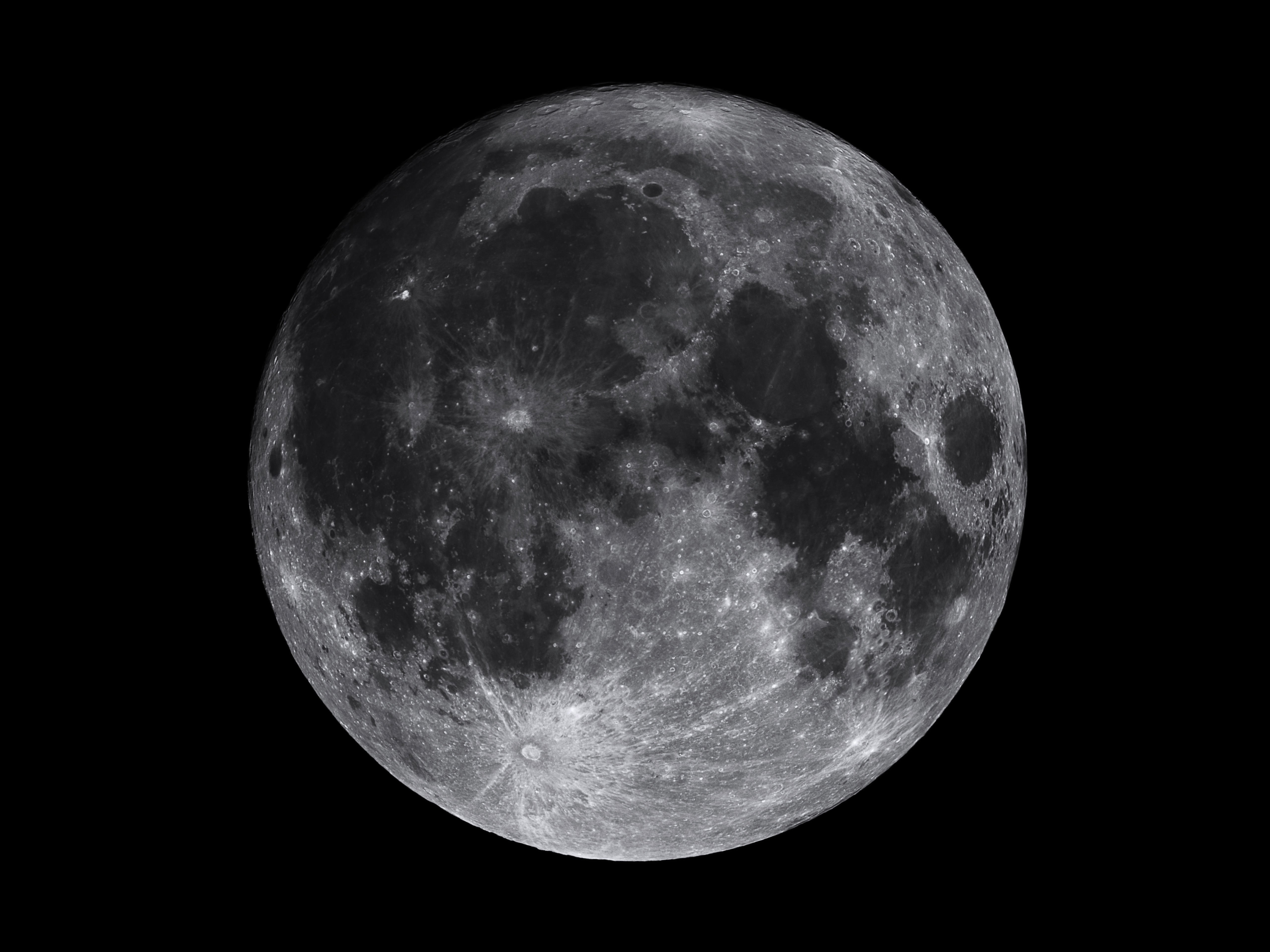
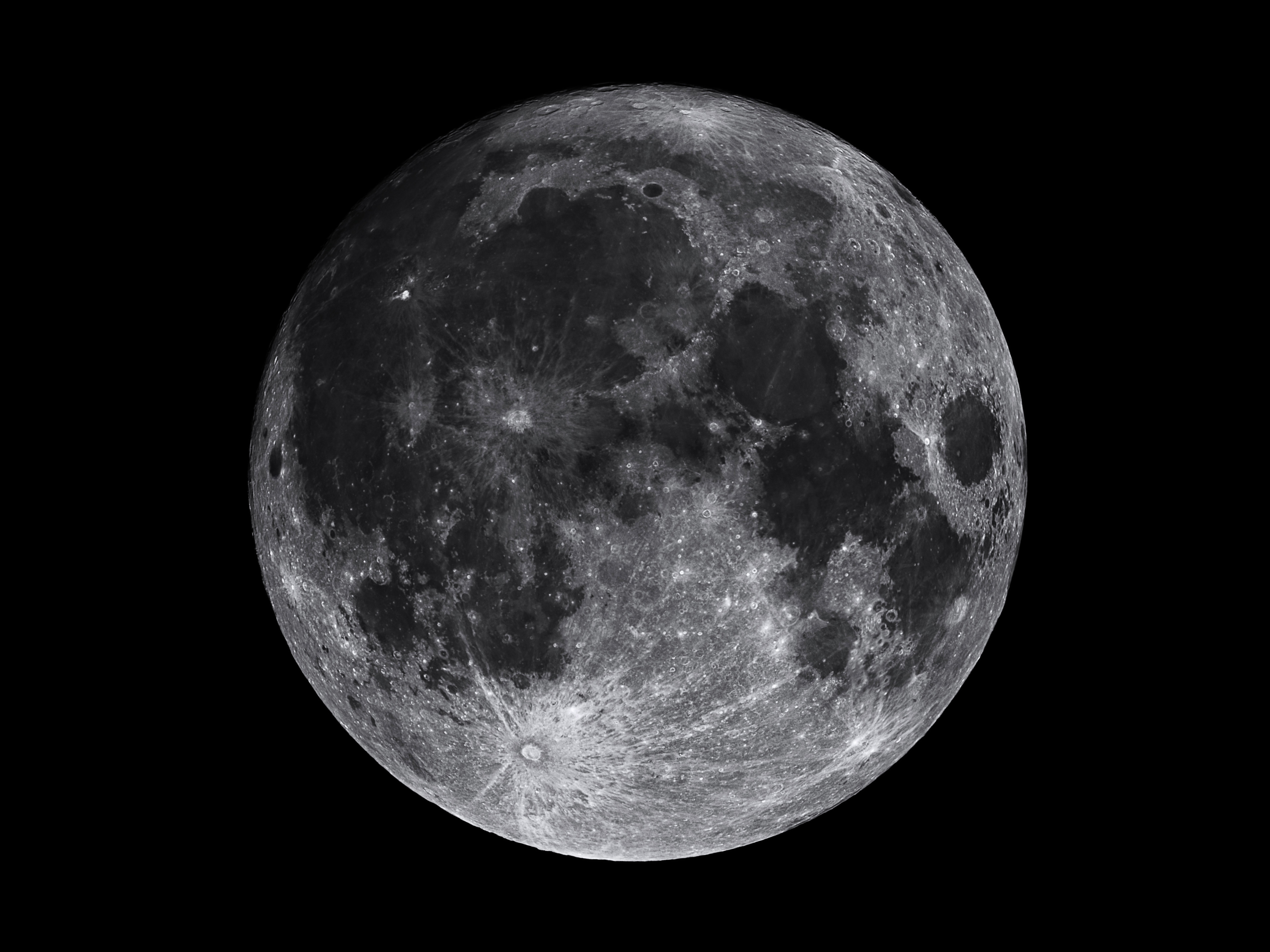
Full “Supermoon” on Nov 14, 2016. Mosaic of 30 panels shot with an Aptina AR0130 color planetary cam. Normal version.
The Supermoon of November 2016 was set to be the biggest of the year. I tried to get a good mosaic of it, but the seeing was poor on this morning, so it is not quite as sharp as I would have liked. The mosaic took about 30 panels to construct and lots of time and effort to put together.
I took this on the morning of the 14th, so there was a chance the seeing was better in the evening when the moon still looked full, but I was too tired to go another round by that time. So, I worked through several iterations of the data I already had and came up with what I think is a reasonably good image.
I also created an enhanced image that is basically just sharpened more. A couple of seams are more obvious in this version, but I figure not bad enough to spend too much time on trying to correct:
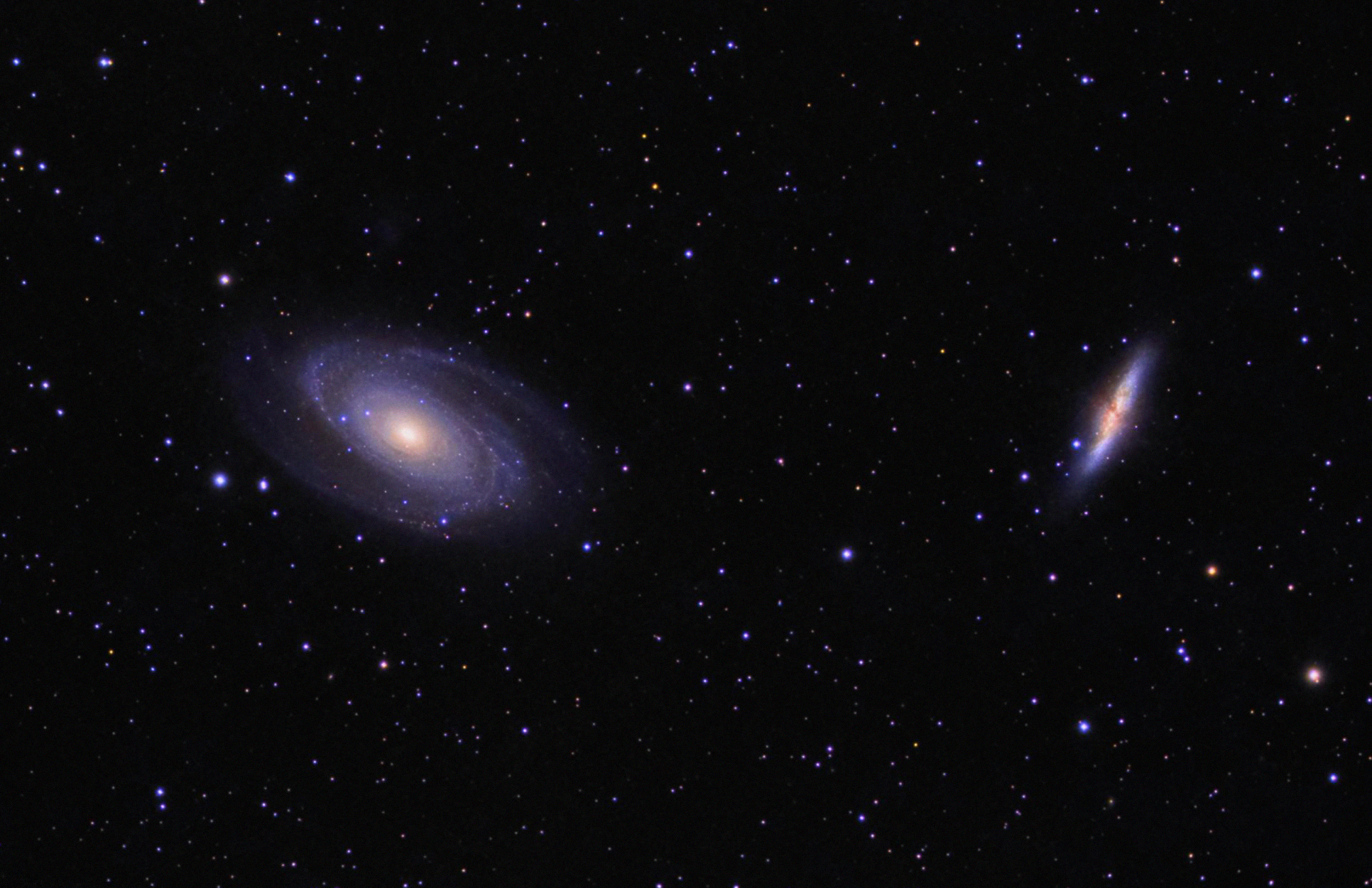
M81 & M82 Galaxies. Combined data from 3 imaging sessions. 350XT as the base image.M81 and M82 Galaxies. Combined data from 3 imaging sessions. T3 as the base image.
I was playing around and noticed I had three different images of this area. Two were taken with the same scope (a Televue TV-85,) but with two different cameras (a Canon 350XT and a Canon T3, both modified.) One was with my Meade SN8 and the Canon 350XT.
With Registar, I was able to align and combine the three images. I used two base images, one with the 350XT as the base and one with the T3 as the base. So, Registar scaled the T3 image down to the resolution of the 350XT in the first image, but scaled the data up in the two older camera images for the second image. I tend to like the larger scale second image more, but the scaled data is softer and not quite as sharp as the down scaled data.
The background in both is still a little noisy, but I think it is tame enough to post. There were lots of faint background galaxies in the full frames, but the one in this view that matters is that smudge just above M81, which is the galaxy on the left. That dim smudge is Holmberg IX, a dwarf satellite galaxy of M81. It is considered a good test of your data, since it is so dim and can be easily swamped by noise and not be seen.
The data I used is from Feb 2007, 24×360 sec @ ISO 1600, SN-8, Canon 350XT, Feb 2008, 41×180 sec @ ISO 1600, TV-85, Canon 350XT and Feb 2012, 39×240 sec @ ISO 1600, TV-85, Canon T3. Total integration of 7.05 hours
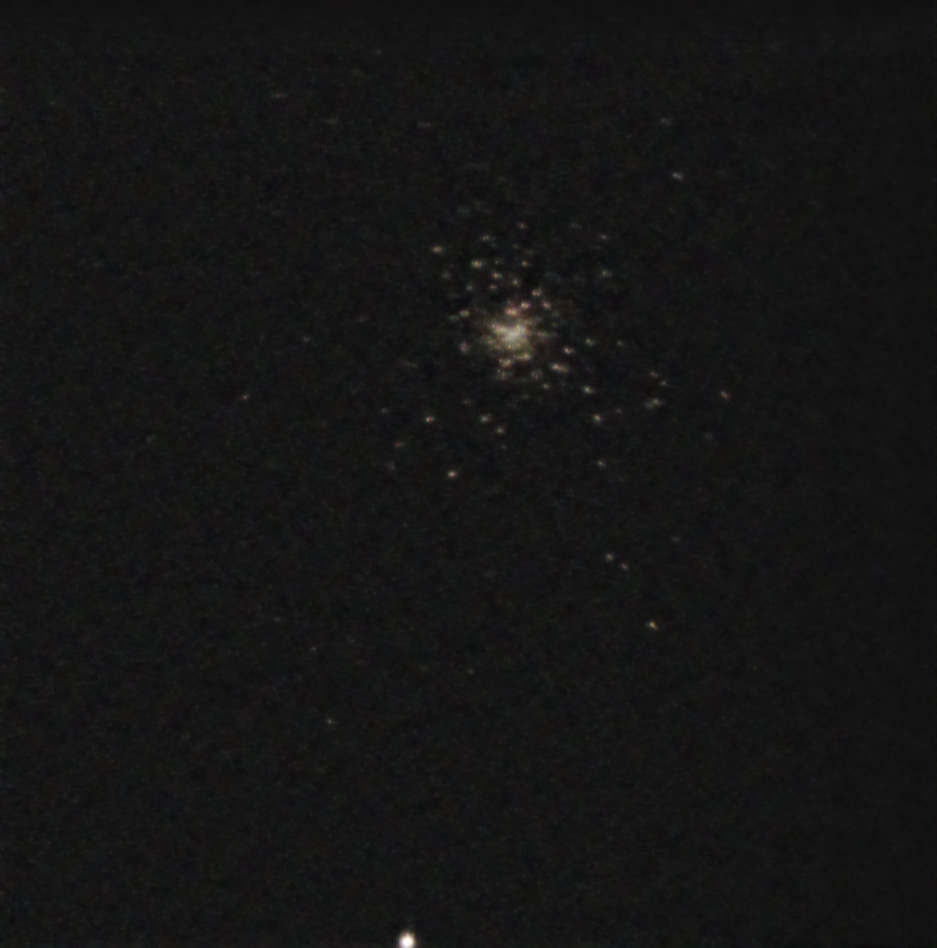
Yes, it is possible to get a DSO image from a Dobsonian scope without an equatorial platform for tracking, but I wouldn’t want to have to do it too many times! lol.
Keeping the object in the field of view is tough. Dealing with hundreds of images and only 25% are usable is a pain. Plus, you have to manually pick and sort them, which is even worse. And after all that effort, you get such meager results like the above? Yeah, like I already said… I wouldn’t want to do this more than I have to. 🙂
Rupes Recta – The Straight Wall on the Moon. 3 frames stacked in IRIS, 2x enlargement, wavelets and unsharp masking. 6″ F/8 and a 1.2 MP color planetary cam.
I’ve always loved this particular feature on the moon. I want to have a night of great seeing and image this with the most powerful stuff I have. The six inch shows it well enough, but my 8 inch scope at f/20 or 4000mm f.l. would really be what’s needed.
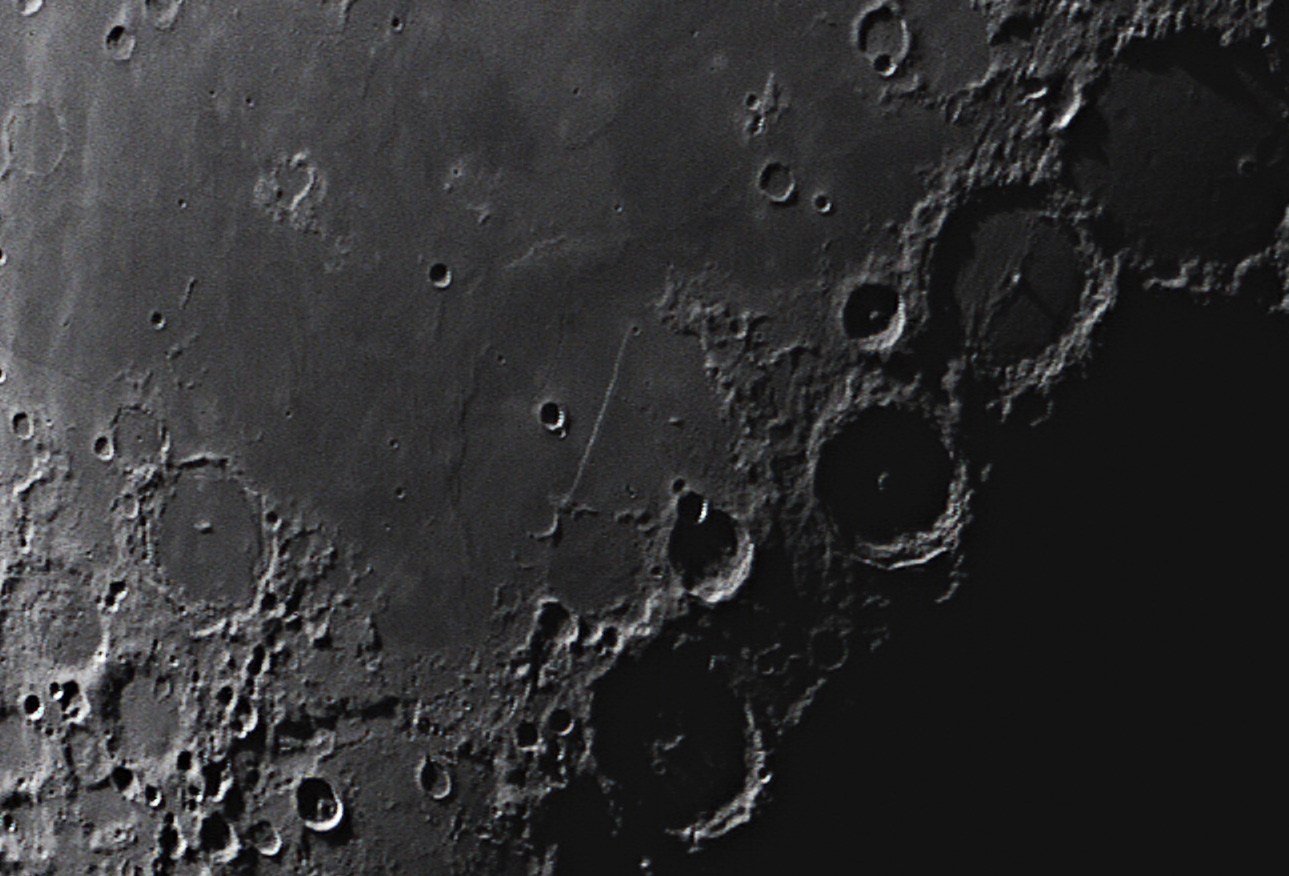
Famous craters Plato, Archimedes and Copernicus on the moon.
This area of the moon includes Mare Imbrium and the three main craters Plato, at the top right, Archimedes, in the lower center and Copernicus on the left below center . Also visible, coming out of the shadows from the right, is a section of the Apennines Mountains. Near the end of the Apennines is Eratosthenes, a crater about half the size of Copernicus that has a prominent central peak.
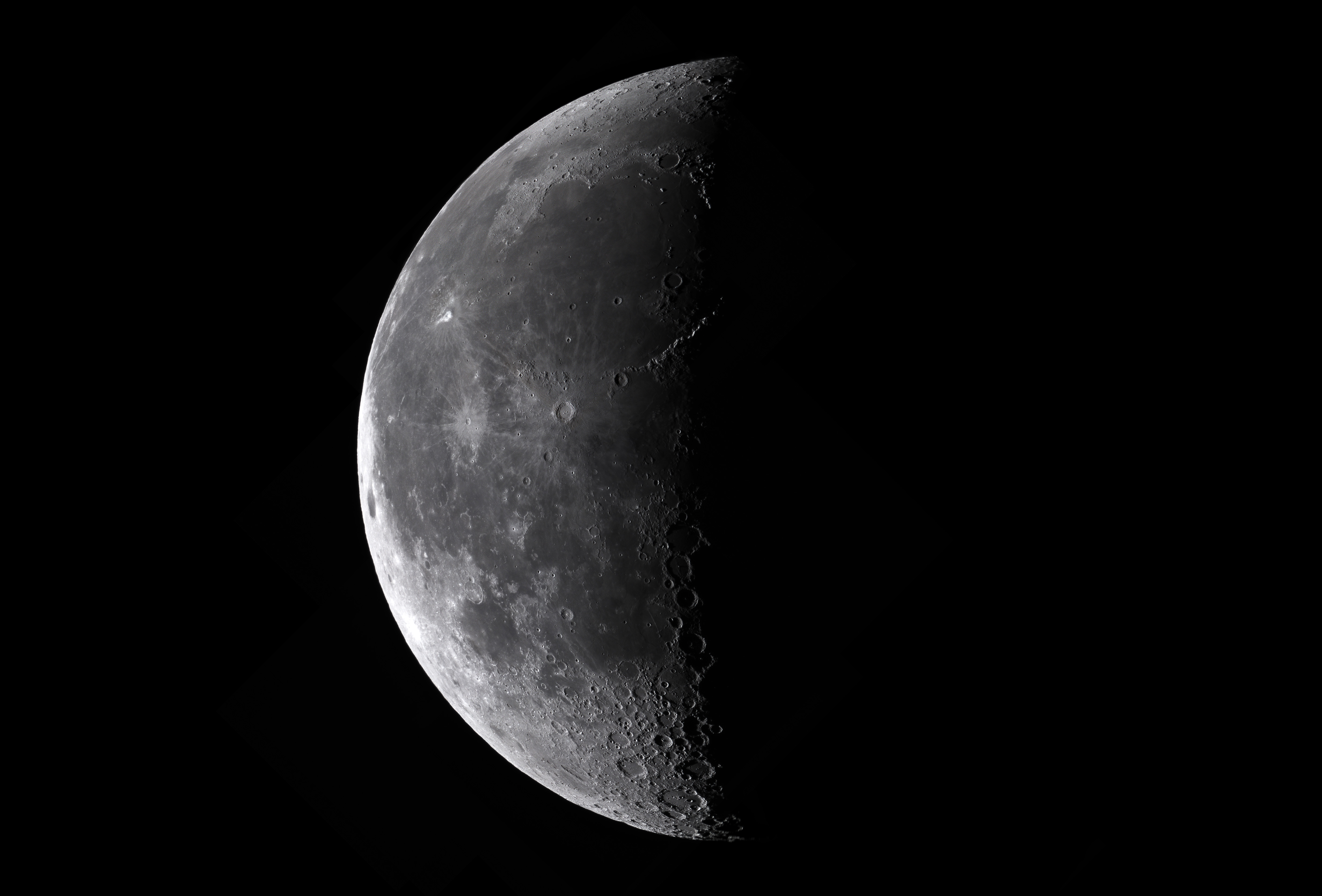
Waning Crescent Moon Mosaic on Oct 23, 2016. 17 panels, 6″ F/8 Newtonian, Aptina AR0130 planetary cam.
Another moon mosaic for the month of October. Since the weather was so clear on this early October morning, I decided to do some more planetary-style imaging with my new planetary/guider cam. Decent seeing and as already mentioned, very transparent skies. It was a little chilly, but not too bad when wearing two coats. 🙂